There are many differenrt approaches to learning. However, according to research, there are three basic types: constructivist, cognitivist, and behaviorist. The following are the views developed and expressed by three learning theorists.
Albert Bandura’s social learning theory places emphasis on the importance of observing, modeling, and imitating the behaviors, attitudes, and emotional reactions of others. “Social learning theory considers how both environmental and cognitive factors interact to influence human learning and behavior. Bandura (1977) agrees with the behaviorist learning theories of classical conditioning and operant conditioning. However, he adds the two important ideas: mediating processes occur between stimuli and responses, and behavior is learned from the environment through the process of observational learning” (Mcleod, 2023).
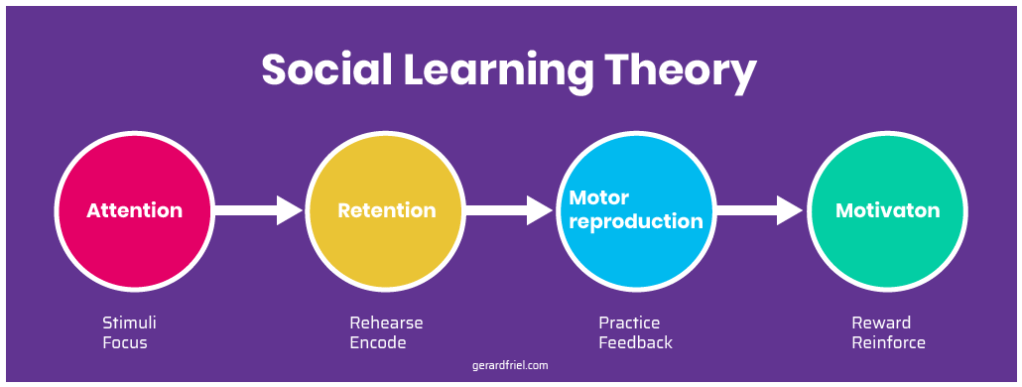
According to Bandura, the four elements of social learning theory, attention, retention, reproduction, and motivation, must be present for learning to take place. If these elements are present during the delivery of instruction, they will have a positive impact on the teaching and learning process. The theory states that “a lesson must engage a student sufficiently to hold their attention. In addition, students must be able to remember what they have seen or heard during the lesson retention. Also, students should be given time to practice the observed behavior reproduction. And finally, a student must be able to see the benefit of a new behavior for long term assimilation”(Loveless, 2023).
Teachers should ensure that they have students’ full attention before they begin to present content material to the students they are teaching. Lessons should be students-centered and provide opportunities for students to be engaged, involve a variety of activities, and use teaching aids that would help in the retention of concepts being taught. It should be noted that observational learning will not be successful if students are not motivated.
One example of this theory is using rewards to support and build motivational learning. Rewarding students will help to increase their interest and participants which will result in improved academic performance. If students are confident about completing a task, they will exert more effort and are more likely to be successful.
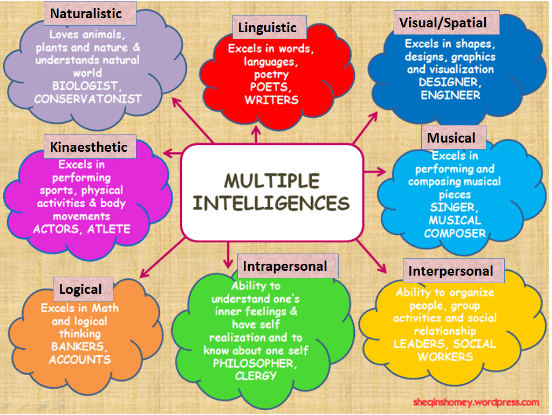
Howard Gardner’s theory of multiple intelligence’s states that “there is more to intelligence than what IQ tests have historically measured” (Lever-Duffy & McDonald, 2018). According to Gardner, the objective tests did not adequately represent the profile of an individual. Instead, he “proposed that each individual has multiple types of intelligence, only a few of which can be measured by current IQ tests” (Lever-Duffy & McDonald, 2018). Gardner theorized nine types of intelligence that every individual has, namely: linguistic (verbal skills and talents related to sound, meanings, and rhythms), logical-mathematical (conceptual and logical thinking skills), musical (talents and abilities related to sound, rhythm, and pitch), spatial (skills in thinking in pictures and visioning, abstractly), bodily-kinesthetic (skill in controlling body movements), interpersonal (responsiveness to others), intrapersonal (self-awareness and insight), naturalistic (recognizing, categorizing, and interacting with the natural world), and existential (ability to consider and deal with questions of human existence) (Lever-Duffy & McDonald, 2018). The theory also states that each person has, to some extent, an aspect of each intelligence but one or more outweighs the others.
Gardner’s theory states that each person uses a different type of intelligence to learn, and each person learns in a different way. Therefore, if a student is viewed as having multiple intelligences, instruction will be presented in a variety of ways, catering to their learning styles. For example, some may learn linguistically by writing and reading, while others learn better using logical-mathematical-that is, thinking conceptually. There might also be others who learn by doing things with their hands-bodily-kinesthetic. As students learn new skills and solve problems, during teaching and learning, acknowledging that there are multiple intelligence’s will help diversify how teaching and learning are done and the impact it should have on students. This theory gives the viewpoint that not everyone can and should be made to learn the same material in the same way. It also states that “people do not have just an intellectual capacity but have many kinds of intelligence” (Cherry, 2023). An example of this theory is providing students with opportunities for problem-solving, using patterns to demonstrate a concept, providing the use of calculators, and creating new information in an outline format are ways to improve learning for a student who learns with logical-mathematical intelligence.
“Cognitive learning theorist, Jerome Bruner based the spiral curriculum on his idea that, “we begin with the hypothesis that any subject can be taught in some intellectually honest form to any child at any stage of development” (Loveless, 2023). He believes that whatever the level of difficulty a concept may be, it can be taught to children if it is presented and structured appropriately. The three main ideas of the spiral curriculum are as follows. “Firstly, students revisit the same topic multiple times throughout their school career which reinforces the learning.
Secondly, the complexity of the topic increases each time a student revisit it. And thirdly, when a student returns to a topic, new ideas are linked with ones they have previously learned” (Loveless, 2023) Bruner also presented three modes of representation which are sequential. “Enactive (0-1 years)-representation of knowledge through physical actions. Iconic (age 1-6 years)-visual representation of knowledge stored via visual images. Symbolic (age 7+ years)-the use of words and symbols to describe experiences” (Loveless, 2023).
There are implications for teaching and learning with the use of Bruner’s learning theory. “Instruction must be appropriate to the level of the learner. This level of awareness will help the teacher to plan and prepare appropriate materials for instruction according to the difficulty that matches the learners’ level. In addition, material must be presented in a sequence since it gives learners the opportunity to acquire and construct knowledge and transform and transfer their learning” (Loveless, 2023). Also, students should be given the opportunity to use their prior experiences to help in acquiring new knowledge in the classroom. As this is done students will be able to make comparisons between new knowledge and what was previously learned. An example of this theory would be instead of explaining to a primary school-aged child the difference between odd and even numbers, it would be best for the child to play a game consisting of sharing various numbers of beads fairly between himself/herself and a friend (discovery learning).
Bandura’s social learning theory focuses on observing and copying the behaviors of others. As a teacher, I can think of several ways that I could use this type of learning. Instead of using the traditional method of learning, I would let students watch an instructional video after which they would apply what they have learned by completing math activities. Also, I could praise and encourage students during learning activities. Other students in the class would observe the actions and behaviors of those students and then they would want to do the same. Activities could be turned into games where students compete against each other, and rewards given to those who win. This would provide a more interactive experience and not only that, but it would also increase motivation and interest in students. Learning would also be more student centered, and concepts would be grasped readily and understood more easily. In return, it would lead to academic success.
Gardner’s theory suggests that learning should be geared toward an individual’s strengths based on their multiple intelligences. As a teacher, it is important that we use a variety of learning materials that could cater to the different types of intelligence. Therefore, if I have students with strong visual-spatial intelligence, I could use a lot of visual aids and hands-on activities with them. And if there are some with strong interpersonal intelligence, I could give then the opportunity to work on group activities and discussions. This would help to create a learning environment that is effective and inclusive.
Bruner believed that learning should begin with concrete objects that children can manipulate. As a teacher, I could use algebra tiles, colored counters, and other manipulative to teach concepts like integers and equations. After this, I could ask students to construct visual representations, like drawing diagrams, that would help them to make connections. I believe that the most important aspects of teaching and learning theories have to do with the variety of ways through which learning is impacted by such theories. For example, I use learning theories to guide my approach to content delivery and classroom management. Additionally, learning theories help me to choose the right or best approach for creating a learning environment that is effective and that provides an inspiring classroom experience. Such as providing students with a structured and comfortable learning environment, ensuring that teaching strategies are suitable to most if not all learners, making sure that students are engaged and that there is collaboration in the classroom; and ensuring that learning goals are aligned to desired outcomes.
Technology can impact behavioral strategies that are beneficial in the classroom to improve learning. The use of technology to perform math drills, for example, can be very effective since it allows students to practice and reinforce concepts that were taught in class. Reviewing concepts regularly helps with retention and it offers a way for students to be given positive reinforcement. Another powerful way that technology can impact aspects of teaching and learning is by allowing students to be active participants in their learning. Students can participate in daily class discussions online by outlining their understanding and interpretation of concepts and by looking at the ideas shared by others. This also leads to collaboration which is vital in teaching and learning theories.
With the use of technology, visual aids can be provided that are likely to improve students’ understanding of new concepts and ensure that students with each type of learning style and intelligence benefit from the learning instruction. Technology also makes it easier to offer differentiated learning. When the same concept is presented and seen in different ways students can complete tasks in their own space and in a manner that they understand the most. As they focus on activities and learn on their own, they develop a sense of responsibility for their own earning.
Another important aspect of teaching and learning where technology can be used to gauge students’ understanding is the involvement in virtual field trips. Field trips allow students to make connections between concepts learned in class and in the real world and help them formulate a better understanding of such. “Whether students use their own devices such as cell phones, or the school provides tablets or laptops to students, having students use technology frequently in the classroom encourages them to do their own probing to learn” (Indeed Editorial, 2023). This allows students to own their learning, and they become more involved in their academic success.
 Instructional Technology EdS
Leave a comment